
How to Plan a Successful Leadership Retreat
A successful leadership retreat comes down to three things:
- Setting a clear purpose
- Building a focused agenda
- Finding a location where your leadership team can think without daily distractions
For small businesses, startups, and hybrid teams, leadership retreats may also be one of the few times every leader is in the same room. Here is how to plan one that ends with real decisions.
What is a Leadership Retreat?
A leadership retreat is a planned gathering where a company’s leaders step away from their normal workspace to focus on strategy, goal setting, and professional development. It can last anywhere from half a day to several days.
Companies hold leadership retreats for a few common reasons:
- Annual planning: Setting priorities, budgets and goals for the year ahead
- Strategy changes: Working through a big shift, like entering a new market
- Leadership development: Building leadership skills through coaching, workshops, and other activities
- Team alignment: Agreeing on a common goal and who owns each part of it
- Connection: Giving leaders who work in different cities time together in person
Gallup’s 2026 State of the Global Workplace report found that manager engagement fell to 22% in 2025, down nine points since 2022. Leadership retreats are a great way to give leaders time to step back, reconnect with their peers, and get clear on priorities.
7 Steps for Planning a Leadership Retreat
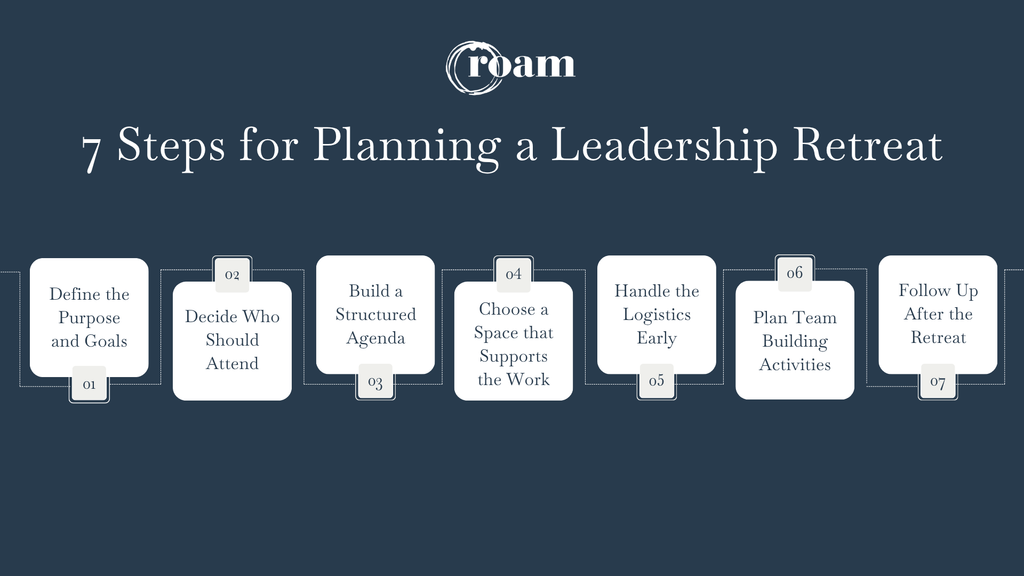
When beginning to plan a leadership retreat, the length of the retreat determines when your planning process happens and when information is shared with attendees. A local one-day retreat usually needs about four to six weeks of lead time. Multi-day retreats with travel need more.
1. Define the Purpose and Goals
Every decision about the retreat, including who attends, how long it runs, and where it happens, should follow from its purpose starts with one question: What needs to be different when the retreat is over?
Limit the conversations to two or three goals. A retreat that tries to cover strategy, budget, hiring, and culture in one day often ends without a decision on any of them.
Examples of clear retreat goals include:
- Agree on the company’s top three priorities for next year
- Decide how the sales team will be structured before Q2
- Create a leadership development plan for each manager
2. Decide Who Should Attend
Smaller groups of about 6 to 15 people make it easier for everyone to speak up. Invite decision-makers, such as department heads, a board member, or an outside facilitator. Also consider employees entering a new leadership role.
Once your list is set, email a short registration form that collects:
- Travel details and arrival times
- Dietary needs
- Topics each attendee wants to discuss
Set a firm registration deadline so you can confirm headcount with your venue.
3. Build an Agenda
“A productive team is proactive instead of reactive,” says Courtney Vann, Senior Sales Executive at Roam. Teams that arrive with a plan can spend their time on the topics that matter most.
A good leadership retreat agenda includes:
- Preparation: Send data or discussion questions a week in advance
- Breakout sessions: Pair discussions with small groups working through specific problems
- Time for reflection: Give attendees quiet time to reflect before switching topics
- Regular breaks: Plan a break every 90 minutes or so
- A closing session: End with clear decisions, action items, and deadlines
Avoid filling every hour. Some of the most useful conversations happen during open time and meals.
4. Choose a Space That Supports the Work
Where you hold the retreat affects how much your team gets done. Staying in the office can lead to easy distractions. For many companies, an offsite meeting space is the better choice because it removes daily distractions without the travel.
When you compare venues, look for:
- A private room sized for your group, plus space for breakout sessions
- Fast, reliable Wi-Fi and video conferencing for remote attendees
- Whiteboards and flexible seating
- Catering that fits your schedule and dietary needs
- An on-site team to handle setup and tech questions
Roam’s meeting spaces include each of these, plus a personal Experience Manager who helps plan the details. Schedule a free tour at one of our Atlanta, Dallas, or Greenville locations to see if our space is right for your next retreat.
5. Handle the Logistics Early
Settle these details at least a few weeks out:
- Date and length: One day works for most small teams. For two days, choose a Thursday and Friday so attendees can head home for the weekend afterward.
- Transportation: Book round-trip transportation early for attendees traveling in.
- Lodging: Reserve a hotel room block near the venue for overnight retreats that are out of town.
- Food and drinks: Confirm menus and dietary needs with your team
- Communication: Send one email with the agenda, address, parking details, and preparation work
6. Plan Team Building Activities
Team building works best when it connects to the retreat’s goals or gives attendees a real chance to know each other.
Good options include:
- Strengths or work style assessment the team reviews together
- Problem-solving challenge built around a real business issue
- Shared lunch or dinner with laptops closed
- An evening group activity like a cooking class or game night
A little time outside the usual comfort zone helps participants see how their peers think. Roam’s curated meeting packages, like All Fun and Games and Renew + Inspire, add some fun or a reset to the day without extra planning on your end.
7. Follow Up After the Retreat
A retreat is only worth the time if the decisions turn into application. Research published in Harvard Business Review found that well-run offsites help employees build new working relationships, and the authors recommend tracking each offsite’s results afterward. Within a week of the retreat:
- Send a written summary of every decision, action item, and deadline
- Ask each participant for feedback on the retreat experience
- Schedule check-ins at 30, 60, and 90 days
- Share key outcomes with the rest of the company
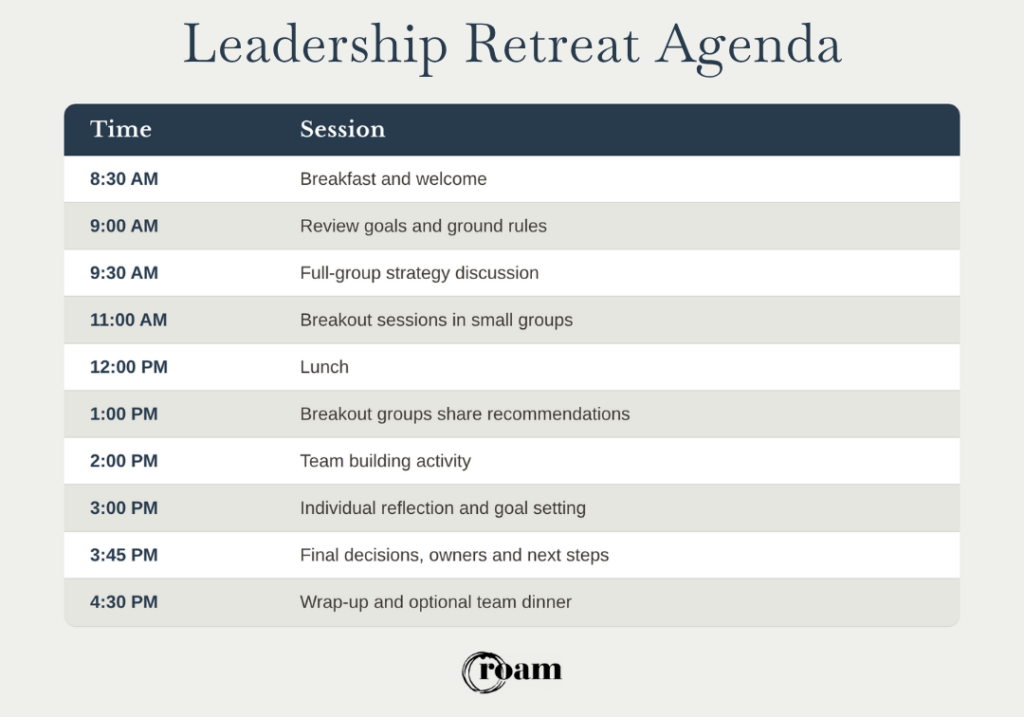
Sample One-Day Leadership Retreat Agenda
Plan Your Next Leadership Retreat at Roam

Roam is a flexible workspace with locations across Metro Atlanta, Dallas-Fort Worth, and Greenville, SC.
Morgan Godbold, Senior Director of Marketing at Roam, puts it this way:
“Our team handles the logistics and hospitality behind the scenes, so leaders can simply show up prepared to lead a productive and meaningful meeting.”
Every meeting space booking includes:
- A personal Experience Manager to coordinate your event details
- Complimentary A/V, HD display, and hybrid meeting technology
- Business-class Wi-Fi and whiteboard space
- Customizable room setup and seating
- Full-service catering from local vendors with no food and beverage minimum
Roam is also a great spot for everyday work. A Roam membership provides hybrid and remote workers a professional home base with access to every Roam location, plus meeting rooms for video calls and client meetings. Need a place to work for just one day? A Day Pass covers that. Growing teams can move into a private office with flexible terms.
Ready to bring your leaders together? Book a meeting room or schedule a tour at the Roam location nearest you.
Frequently Asked Questions
A one-day retreat is enough for most small leadership teams working on two or three goals. Annual planning retreats and larger groups may need two to three days. A half day works well for one focused topic.
Plan a local one-day retreat four to six weeks ahead. For multi-day retreats with flights and a hotel room block, start two to three months out.
Include a review of retreat goals, full-group strategy discussions, breakout sessions, a team-building activity, time for reflection, and a closing session that assigns an owner and deadline to every decision.
Yes. Roam offers meeting rooms, luxury boardrooms, and training rooms across Metro Atlanta, Dallas-Fort Worth, and Greenville, SC. Every booking includes a personal Experience Manager, complimentary A/V and business-class Wi-Fi, with no food and beverage minimum.
Yes. Roam’s meeting rooms include hybrid meeting technology, with Apple TV, webcams, and conference phones available on request, so remote attendees can join by video.