
How to Keep a Distributed Team Motivated and Connected
The Short Answer: Keeping a distributed team motivated and connected comes down to a few things done consistently: clear goals, honest communication, recognition that feels real, and intentional moments of in-person connection. Remote flexibility keeps people productive day-to-day, but it’s the time spent together that builds culture and trust. And here’s the truth: the strongest distributed teams still come together in person, just on their own terms.
Distributed teams have become the standard for startups, growing companies, and enterprises alike. The model brings real upside: access to talent regardless of location, lower overhead, and employees who get to work closer to home. The harder part is what slips when everyone is spread out. Motivation dips, connection fades, and a shared sense of purpose gets harder to hold. When people rarely sit in the same room, leaders have to be more deliberate about how they keep a team engaged.
Knowing how to motivate employees in this setup is less about perks and more about consistency. The leaders who do it well treat motivation as a system, not a one-time push: a steady mix of purpose, communication, recognition, and connection that holds up whether someone is logging in from a home office or a coworking space two states away. Below are practical ways to build a motivated workforce across locations, plus how a flexible space can give your distributed team a home base when it matters most.
What Is a Distributed Team?
A distributed team is a group of employees who work for the same company from different locations instead of one central office. Some companies are fully remote, with every team member working from home or a nearby coworking space. Others use a hub-and-spoke setup, where a smaller headquarters anchors the company while people work closer to where they live.
The term overlaps with “remote team,” but there is a useful difference. Remote describes where an individual works. Distributed describes how the company is organized. That distinction matters for motivation: in a single office, culture builds on its own through hallway conversations and shared routines, while on a distributed team those moments have to be planned. Knowing how your team is structured is the first step in figuring out how to motivate employees within it.
Connect Daily Tasks to the Bigger Picture
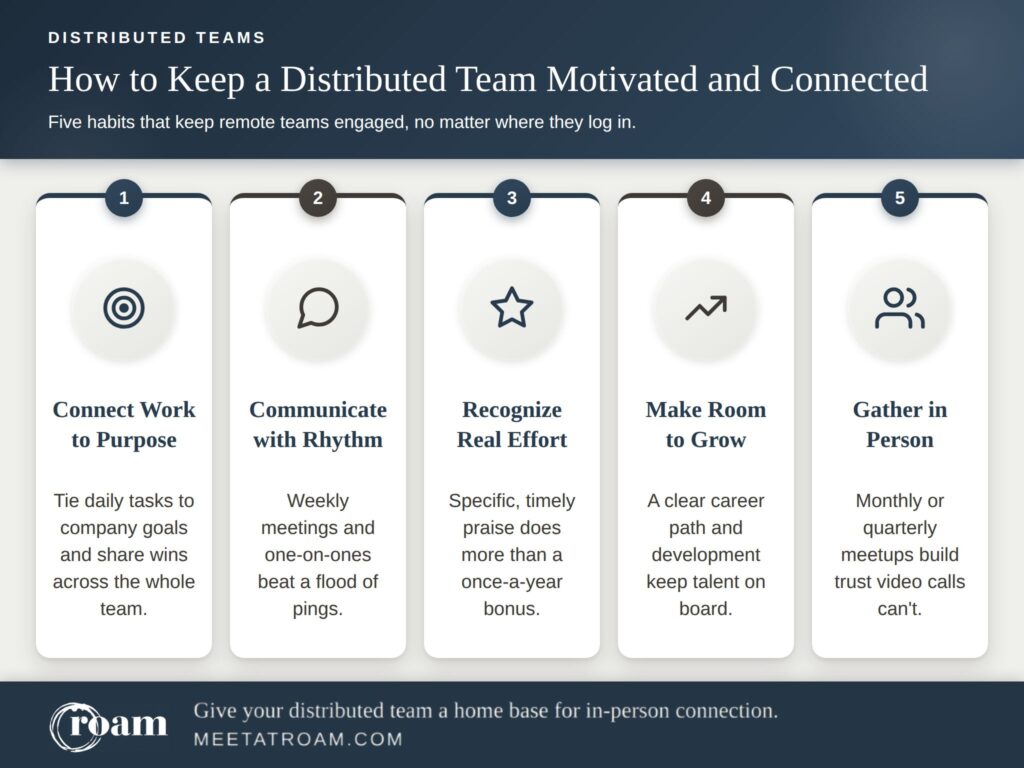
People stay motivated when they understand how their daily tasks contribute to organizational goals. Remote employees in particular can lose sight of the bigger picture when they’re heads-down at home for weeks at a time. Clear goals close that gap.
A few habits keep purpose front and center. Tie individual projects to the company’s goals so every team member sees their impact, and revisit priorities on a regular basis rather than only at annual reviews. Sharing wins across the whole team helps too, so progress feels collective rather than siloed.
Meaningful work is one of the top reasons employees stay engaged. When people see the “why” behind a task, intrinsic motivation does a lot of heavy lifting that no extrinsic reward can replace.
Make Communication Intentional, Not Constant
Effective communication on a distributed team is about rhythm, not volume. Flooding inboxes and chat channels creates noise. Regular check-ins create a connection. The goal is a cadence your team can count on:
- Hold weekly meetings with a clear plan so time together drives real progress
- Schedule regular one-on-ones for honest, two-way conversation
- Ask open-ended questions to surface what status dashboards miss
Active listening matters as much as talking. When leaders practice it, they build psychological safety, the sense that people can speak up, share ideas, and admit mistakes without fear. Open communication is what keeps a remote team member from feeling like an island.
That rhythm only works when each meeting has a purpose. Senior Sales Executive Courtney Vann puts it this way:
“A productive team is proactive instead of reactive. They have a plan in place going into their meeting, so they can show up and meet about the topics that matter and push the needle forward.”
Recognize Effort and Create Room to Grow
Recognition is one of the simplest motivators and one of the most overlooked on remote teams. Positive feedback that’s specific and timely reinforces the behavior you want to see. Employees who don’t feel adequately recognized are twice as likely to say they’ll quit in the next year. A quick note of positive reinforcement after a strong week costs nothing and does more for employee satisfaction than most managers expect.
It helps to understand the two engines behind employee motivation:
- Intrinsic motivation comes from within: meaningful work, autonomy, and growth
- Extrinsic motivation comes from outside: financial reward, competitive compensation, and other extrinsic rewards
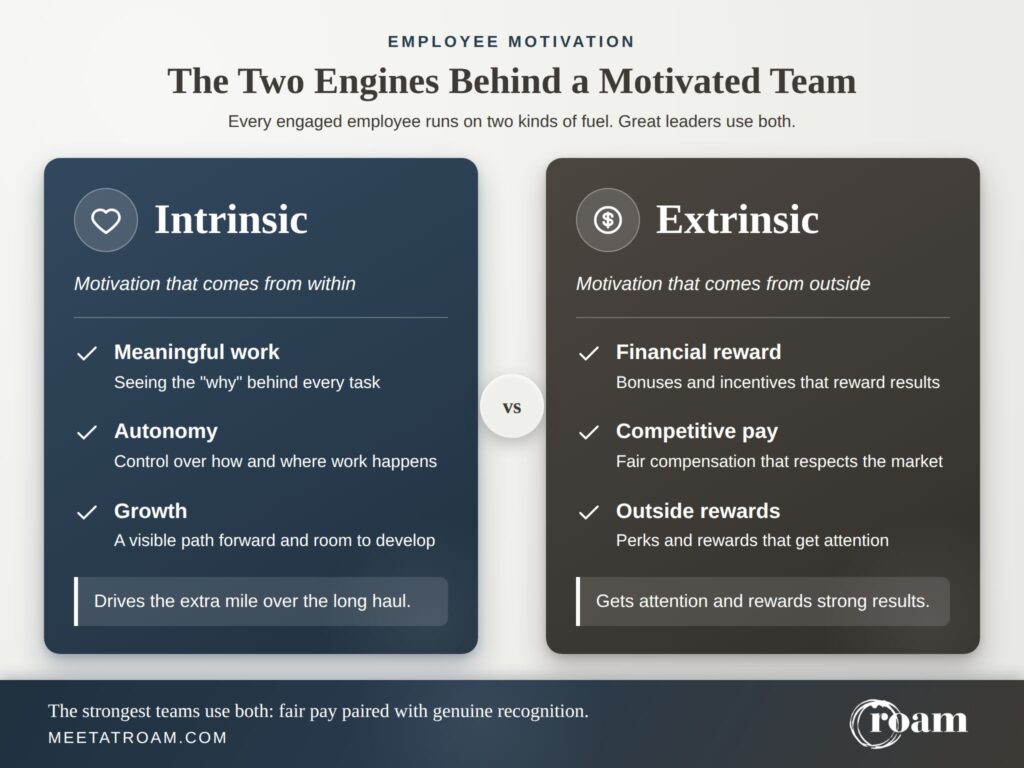
Both have a place. Extrinsic motivators get attention, but intrinsic motivation is what drives the extra mile over the long haul. Pair fair pay with genuine recognition, and you get greater motivation that holds up over time.
Growth keeps people, too. Make it part of the culture by offering professional development and visible chances to advance. Give employees a clear career path so they know where their hard work leads, and back it up with constructive feedback rather than praise that only feels nice. When career development is built into how the team operates, job satisfaction rises. Retention follows, and holding onto good people is a real edge in a market where they have options.
Bring People Together in Person
Here’s what distributed teams miss most: the energy of being in a room together. Video calls handle information well. They don’t build the relationships that hold a team together through a hard quarter. That’s why intentional in-person time has become the heartbeat of distributed culture.
Many companies now lean on a hub-and-spoke model, letting people work close to home most of the time while gathering at a shared space for collaboration, kickoffs, and team building.
Senior Director of Marketing Morgan Godbold has watched that shift firsthand:
“Many organizations now see [the office] as a hub for collaboration, connection, culture, and team gatherings.”
The environment you choose for those gatherings matters more than people expect. A distracting or uninspiring space works against connection, while a welcoming, professional one sets the tone before the first agenda item.
Meeting Spaces Built for Distributed Teams
This is where Roam fits in. Roam’s meeting spaces give distributed teams a polished place to gather, with complimentary A/V, fast Wi-Fi, and a dedicated Meeting Coordinator who handles the details so leaders can focus on the people in the room. Members can also tap into multiple locations across Atlanta, Dallas, and Greenville, so teams can meet wherever business takes them without booking fees or preregistration.
Build Flexibility Into the Way Teams Work
Flexibility is no longer a nice-to-have. It’s an expectation, and it directly shapes motivation. Flexible scheduling and flexible work arrangements signal trust, and trust fuels employee engagement.
For enterprises and growing companies, flexibility also makes plain business sense. Since the pandemic, people have come to value the well-being and productivity that come from working closer to home, and employers have seen they can recruit and retain talent without tying everyone to a single location.
What a Flexible Setup Gives Your Team
A flexible approach supports the things employees value most:
- Work-life balance that protects against burnout
- Autonomy over how and where focused work happens
- A professional space for client meetings and team offsites, without signing a long-term lease
When you give people room to work in different ways and still create regular moments to connect, you protect both productivity and morale. It also widens your hiring pool, since you’re no longer limited to candidates within commuting distance of a single office. That balance is what keeps a distributed team feeling like one team.
Roam: A Home Base for Distributed Teams

At Roam, hospitality meets functionality. We give distributed teams, startups, and enterprises a flexible home base across Atlanta, Dallas, and Greenville, with memberships, private offices, and meeting spaces designed to help people do their best work and feel genuinely cared for. No long-term lease. No food and beverage minimums. Just a professional, welcoming environment and an onsite team that treats your goals as their own.
Ready to bring your distributed team together? Book a meeting space or tour a Roam location and see how the right environment keeps people motivated and connected.
Frequently Asked Questions
Focus on consistency over perks. Connect daily tasks to clear goals, hold regular check-ins, give specific positive feedback, and offer professional development. Pair that with intentional in-person gatherings, since connection and meaningful work drive employee motivation more than any single reward.
Intrinsic motivation comes from within, like meaningful work, autonomy, and growth. Extrinsic motivation comes from outside factors such as financial reward and competitive compensation. The strongest teams use both, leaning on intrinsic motivation to encourage the extra mile and extrinsic rewards to recognize results.
There’s no single rule, but many distributed teams gather monthly or quarterly for collaboration, kickoffs, and team building. A hub-and-spoke setup, where people work close to home and meet at a shared space like Roam, makes regular in-person connection easy without committing to a permanent office.
Environment shapes focus, energy, and engagement. A distracting or uninspiring space drains motivation, while a professional, welcoming one helps people do their best work. As Roam’s team puts it, environment directly correlates with quality of work, which is why intentional spaces matter for in-person gatherings.
Yes. Flexible work arrangements support work-life balance and signal trust, both of which lift employee satisfaction. Access to a professional space for meetings and offsites, without a long-term lease, helps companies stay agile while giving teams an inspiring place to connect.