
Salary vs. Hourly: How to Decide What’s Right for Your Team
The Short Answer: The choice between salary and hourly pay depends on the job and the law. Salary works best for steady roles with consistent hours and duties that involve independent judgment. Hourly works best for roles where the hours change often or overtime is common. Before you decide, be sure to check the classification rules, because federal and state law require a specific setup for many positions.
Classifying a role as salaried or hourly looks like a simple call on the surface, but it carries real consequences for payroll, compliance, and the kind of talent you attract. When you classify a role correctly, you set clear expectations and stay on the right side of federal and state law, while a misclassification can lead to back pay, penalties, and frustrated employees.
The decision comes down to a few connected factors: what the job actually involves, how the hours vary, what your budget can support, and what the law requires where your team works. The sections ahead walk through each one, from the legal tests that set the rules to the questions that help you land on the right fit.
The Difference Between Salary and Hourly Pay
The difference between salary and hourly pay goes beyond how often you run payroll. Each model follows its own rules for hours, overtime, and benefits.
A salaried employee earns a fixed amount spread across the year, usually paid the same in each pay period, regardless of how many hours the week requires. A $70,000 annual salary comes to about $2,692 every two weeks, whether the person worked 38 hours or 45.
An hourly employee earns an hourly rate for the number of hours they actually work. At $25 per hour, 40 hours of work comes to $1,000 before taxes. If they work fewer hours, they earn less. If they work more than 40 hours in a week, you often owe them overtime pay.
This may seem like a simple payroll decision, but it is also a legal one. For small business owners, the legal side is usually more important than the budgeting.
The Exempt vs. Non-Exempt Distinction
In the United States, the Fair Labor Standards Act (FLSA) divides workers into two groups: exempt and non-exempt. Whichever group an employee’s role falls into determines whether they qualify for overtime.
- A non-exempt employee must be paid at least the federal minimum wage and receives overtime compensation for any hours worked over 40 in a week.
- An exempt employee is not owed overtime, but their role must meet specific requirements to qualify for that status.
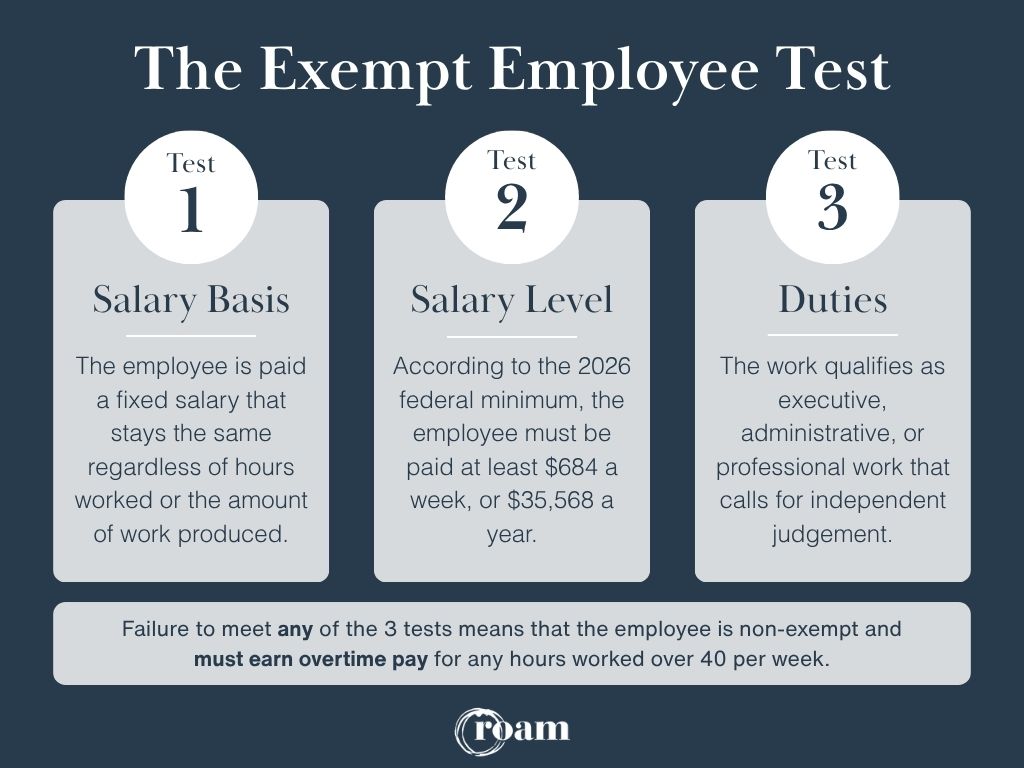
Under federal law, a role generally has to pass all three of the following tests to be classified as exempt:
- Salary basis test: The employee receives a set salary that stays the same from one pay period to the next. Their pay does not rise or fall based on how much work they complete or how well they do it.
- Salary level test: The salary meets the federal minimum for exempt status. In 2026, that minimum is $684 per week, or $35,568 per year.
- Duties test: The employee’s core responsibilities are executive, administrative, or professional, and the role requires independent judgment on meaningful decisions. A senior-sounding title on its own does not satisfy this test.
If a role fails even one of these three tests, the employee is non-exempt, and overtime rules apply whether you pay a salary or an hourly wage. This means an employee can be paid a salary and still be owed overtime, a detail many employers overlook.
How State Laws Factor In
Federal rules set the minimum standard, and states are allowed to require more. The federal minimum wage is $7.25 per hour, but many states set a higher rate. Several states also require a higher minimum salary for exempt status than federal law does. States such as Georgia, Texas, and South Carolina use the federal minimum, while California and Washington are well above it.
For a team that works across more than one state, the rules depend on where each employee is located. A hybrid team split across three states may have to follow three different sets of overtime rules and minimum wage requirements in the same pay period.
When Salaried Pay Makes Sense
Salary tends to fit roles where the work is steady, output matters more than exact hours, and predictable costs are a priority. Consider salary pay when:
- The role involves independent judgment: Managers, specialists, and licensed professionals who make their own decisions usually fit the salaried, exempt profile.
- You want predictable labor costs: A fixed salary stays the same on your books, which makes budgeting simpler than forecasting variable hourly pay.
- You are competing for full-time talent: Salaried positions often signal stability and usually include additional benefits that employees look for, such as health insurance, a retirement plan, and paid time off.
- The hours stay consistent: When a role rarely requires extra hours, tracking time by the hour often creates more work than it saves.
There is also a work-life balance factor. Salaried employees often trade strict time tracking for flexibility in how and when they complete their work, which many people value as much as the pay itself.
When Hourly Pay Makes Sense
Hourly pay works well for roles with changing schedules, and for jobs where paying for exact time worked is the more accurate approach. Choose an hourly model when:
- The hours vary from week to week: Seasonal, part-time, and shift-based roles are a natural fit for an hourly rate.
- Overtime is a regular part of the job: When a role often runs past 40 hours, an hourly wage with built-in overtime compensation keeps you compliant and pays people fairly for the extra work.
- You want to pay for exactly what is worked: Paying on an hourly basis keeps labor costs in line with the hours actually put in.
- The duties do not meet the exempt standard: If a role cannot pass the duties test, classifying it as hourly and non-exempt keeps you within federal law.
Hourly workers also benefit from a clear regular rate. When they work more than 40 hours in a week, they earn overtime pay at 1.5 times their regular rate. This higher rate compensates them directly for the additional hours.
How to Choose the Right Pay Model
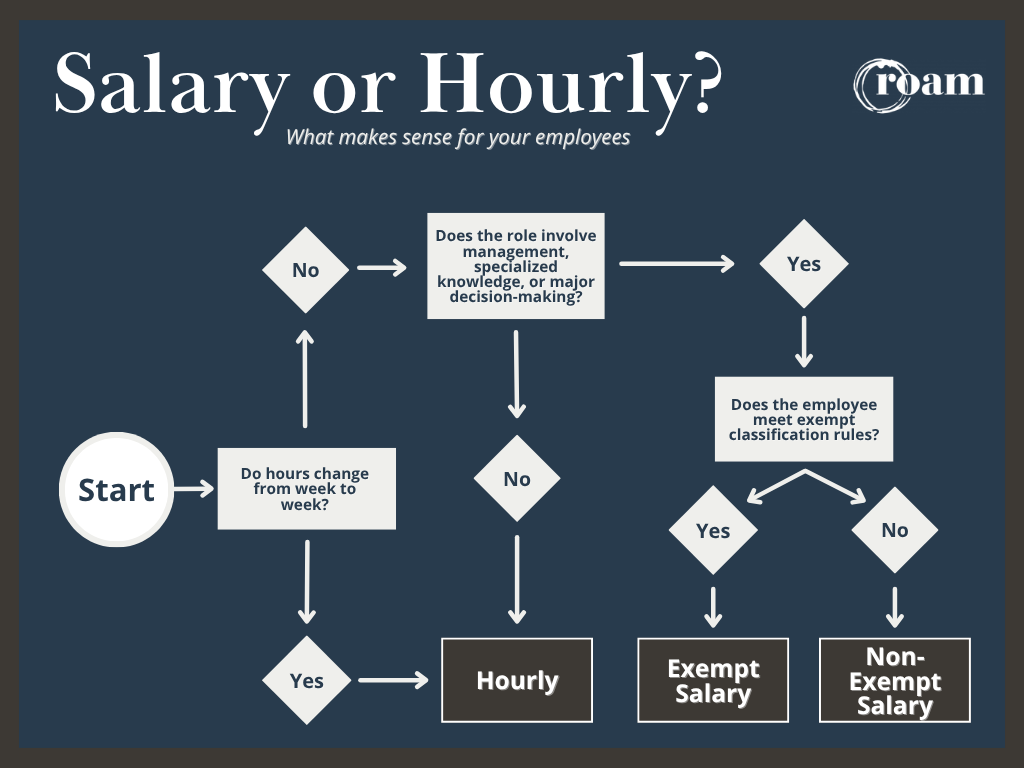
Answering these five questions in order makes the decision clearer:
- What does the role actually involve? Start with the duties test rather than the title. The daily responsibilities determine exempt status.
- How much do the hours change? Steady, predictable hours point toward salary. Variable hours point toward hourly.
- What does your budget need? A fixed salary gives you certainty, while hourly pay keeps costs tied to time worked.
- What does the talent market expect? Some roles are widely expected to be salaried, full-time positions with benefits.
- What do state laws require? Confirm the minimum wage and minimum salary thresholds for every location where your team works.
One more point on the employment contract: whichever model you choose, put the classification, pay basis, and expectations in writing. A clear offer letter prevents most misclassification problems later on.
Why the Workspace Matters Just as Much

How you pay your team is one part of building a productive workplace. Where they work is another. As hybrid and remote models have become common, companies are rethinking the workspace at the same time they rethink pay.
As Morgan Godbold, Senior Director of Marketing at Roam, puts it,
“Flexibility has become less of a perk and more of an expectation for today’s workforce.”
That holds true for salaried and hourly team members alike. People produce better work when they have a space built for focus instead of being surrounded by distractions.
This is where Roam helps. Salaried or hourly, every team member needs a dependable place to do focused work. Anyone who has run a client call over an unreliable home connection or searched for a quiet seat in a busy cafe understands the point.
Teams use Roam in different ways depending on how they work:
- Remote and hybrid workers get a professional home base with fast, secure wifi and quiet space to focus, closer to home than a corporate headquarters. Explore coworking memberships to see how a flexible desk works.
- Distributed teams meet in person to reconnect, plan, and build culture. Book a meeting space with complimentary A/V and a dedicated coordinator who handles the logistics.
- Growing companies scale into private offices on month-to-month terms, without committing to a long commercial lease.
- Team members with a virtual meeting on the calendar can reserve a private room rather than joining from a noisy coffee shop.
Deciding What Fits Your Team
Choosing between salary and hourly pay is a decision worth getting right the first time. Start with what the role actually does and what the law requires, then factor in your budget, your hiring goals, and the rules in each state where your team works. When the classification matches the job, you stay compliant, set clear expectations, and give your team a pay structure that holds up over time. The way you support your team once they are on payroll matters just as much, and a dependable place to work is part of that picture.
Ready to give your team a better place to work? Explore Roam locations or book a tour to see the space in person.
Frequently Asked Questions
Neither is universally better. Salaried roles offer steady, predictable pay and often more schedule flexibility plus benefits, while hourly roles pay for every hour worked and include overtime pay for extra hours. The right fit depends on the job duties, how much the hours vary, and the classification rules that apply.
Yes. Paying a salary does not automatically make someone exempt. If the role fails the salary level or duties test under the FLSA, the person is a non-exempt employee and is owed overtime compensation for hours over 40 in a workweek, even on a fixed salary.
Under federal law, an exempt employee generally must earn at least $684 per week, which works out to $35,568 per year. Some states set a higher minimum salary, so check the rules for each employee’s work location.
They can. Benefits such as health insurance and a retirement plan are set by employer policy, not by whether someone is paid hourly or salaried. Many employers offer additional benefits to both full-time hourly workers and salaried staff.
Yes. Roam serves remote professionals who need a focused home base, distributed teams that gather for meetings, and growing companies that want private office space without a long lease, all across Atlanta, Dallas-Fort Worth, and Greenville.