
Colleague vs. Coworker: What’s The Difference?
The Short Answer: Coworker and colleague are two terms that get used interchangeably, but they don’t actually mean the same thing. A coworker is someone you share a workplace with at the same company. A colleague is someone in your same profession, even if they work at a different organization. However, the line often blurs in the modern workplace, especially for hybrid and distributed teams. The bigger truth: no matter which word fits, the people you work with still need a real place to gather sometimes.
Use the word coworker in a Tuesday morning Slack message and no one will blink. Use the word colleague in the same channel and someone might assume you’ve been reading too many corporate style guides. The two terms get swapped constantly, but they describe slightly different professional relationships, and the difference shows up in everything from a job description to a thank you email.
Here’s what each word actually means, when to use them, and why no matter which one, it matters to connect with them in person.
What “Coworker” Actually Means
The word coworker refers to someone who works at the same company you do. They might sit one desk over, lead a different department, or report up to a different boss. The shared factor is the employer.
A coworker can be someone in a similar role on your team, someone in a totally different role at the same company, the administrative assistant who keeps the office running, or the person in customer service who picks up the phone when you call.
The word coworker is more common in American English. It tends to feel a little more casual and a little less hierarchical than colleague. The word doesn’t carry much weight beyond the fact that you both receive paychecks from the same organization.
What “Colleague” Actually Means
The term colleague is significantly broader. A colleague is someone in your same profession or field, whether or not you work at the same company. Two social workers at different agencies are colleagues. A police department detective and a detective at a neighboring precinct are colleagues. A nurse at one hospital and a nurse at another are colleagues, even if they’ve never met.
The word colleague is more common in British English, though it’s used plenty in American English too, especially in professional settings where the speaker wants to signal respect. It implies peer status. You’re equals in some way, often by skill set or shared profession, even if your specific role and job description differ.
A colleague can be a peer at a different organization in your same field, a former coworker you now consider a peer, an individual you met at a conference, or a connection from a regulatory body or industry group you collaborate with.
The word colleague carries a slight formality. It’s the right choice for an introduction, a published bio, or a general statement about your professional network. It’s also the word more likely to show up in a positive affirmation about your team.
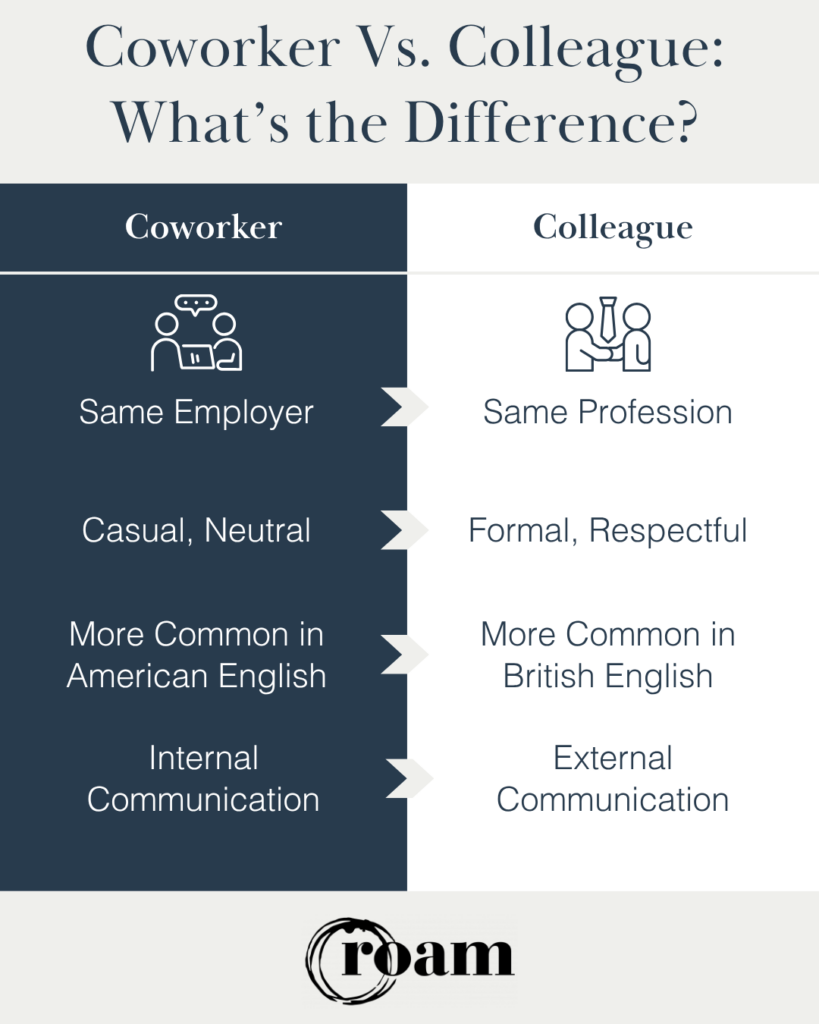
Coworker vs. Colleague at a Glance
A simple way to think about it:
- Coworker = same company
- Colleague = same profession or field, any company
- A lot of people are both at once
In most cases, your coworkers are also your colleagues. The person two desks down doing the same job is both. The distinction matters most when you’re describing a person who isn’t a coworker but is still a part of your professional world.
Why the Distinction Shows Up in the Modern Workplace
The two words carry slightly different emotional weight, which is why they aren’t always interchangeable.
- Coworker tends to be neutral or descriptive. It works for a sick coworker email, a thank you to a former coworker, or when talking about other people on the team.
- Colleague tends to be more elevated. It implies respect, peer status, or shared expertise. Saying “my colleague will follow up” lands differently than “my coworker will follow up” in a client email.
- The distinction matters more in formal writing. Human resources documents, professional bios, and external communications usually default to colleague. Internal Slack messages default to coworker.
For a lot of people, the choice is mostly intuitive. The word that comes out depends on the audience, the work environment, and the relationship.
When the Words Don’t Quite Fit Anymore
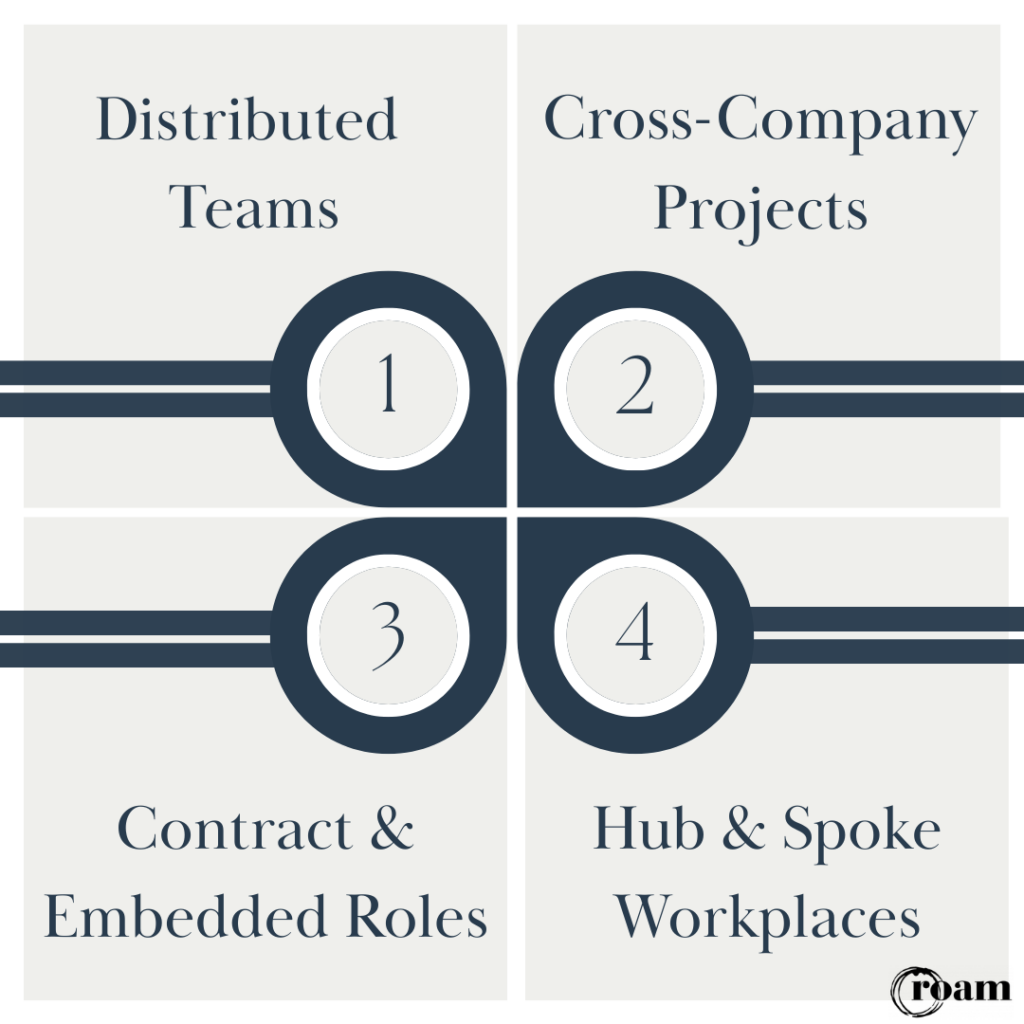
The modern workplace has stretched both terms. Hybrid work, distributed teams, contract roles, and the rise of cross-company collaboration all mean the old “we share a building, so we’re coworkers” framing doesn’t always apply.
A few current realities that complicate the words:
- Distributed teams where team members live in different cities and rarely meet in person
- Cross-functional projects between two different companies that put colleagues from different organizations on the same Slack channel for months
- Short term contract roles where someone is embedded in your team but employed by a different company
- Hub and spoke models where employees split time between a central office and regional flex spaces
The result: the people you call coworkers might live three states away. The people you call colleagues might be working on the same product as you for the next six months.
Why Distributed Teams Still Need a Real Place to Meet
Whatever word you use, the relationship gets stronger in person. A distributed team that only sees each other on video calls misses the small moments that build trust: the side conversation before a meeting, the lunch after a workshop, the coffee that turns into a planning session. Mental health, work-life balance, and personal life all benefit from in-person interaction, even when the work itself can be done remotely.
This is where a flexible workspace earns its place. A Roam membership gives distributed teams and cross-company groups a professional setting to gather without the overhead of a permanent office.
Common use cases:
- Quarterly in-person team meetings for fully remote companies
- Client meetings where colleagues from two different organizations meet face to face
- Onboarding sessions for new team members joining a hybrid team
- Industry meetups for colleagues from a regulatory body or professional association
- Weekly open spaces for remote or hybrid coworkers to connect
Brad Kirch, Managing Partner at Roam Peachtree Corners, sums up the value of the flexible model:
“In today’s professional environment, office space doesn’t have to be a company’s permanent headquarters. There are tons of advantages to the flexible work model, including low-commitment lease terms, accelerated team growth, and the ability to use multiple office locations in different markets.”
How Roam Supports Connection Across Both
Roam is built for the kind of work that doesn’t fit neatly into a traditional office. Roam members gain access to:
- Coworking memberships for individuals and teams
- Private offices that flex up and down with team size
- Meeting and event spaces with on-site hospitality and complimentary A/V
- Multiple locations across Atlanta, Dallas, and Greenville for hub and spoke teams
- All-inclusive amenities including an onsite coffee bar, printing, mailing address and more
Halston Arterburn, Senior Community Manager at Roam, describes the ideal member this way:
“Our ideal Roam members are those who need a reliable, flexible, productive workspace. Our goal is to eliminate the worry and stress of maintaining an office space on your own.”
For distributed teams, that means a place to bring everyone together a few times a year, or a few times a week. For cross-company colleagues, it means a neutral, professional setting for joint work. For local coworkers, it means a workspace that feels like an actual workplace.

About Roam
Roam operates flexible workspaces and meeting venues across Atlanta, Dallas, and Greenville. Locations include Alpharetta, Buckhead Peachtree, Buckhead Piedmont, Dunwoody, Galleria, Peachtree Corners, Perimeter Center, Trilith, Dallas Grandscape, and Greenville ONE.
Members gain access to coworking memberships, private offices, meeting and event spaces, and the kind of hospitality you don’t get at a typical coworking space. Ready to bring your team, your colleagues, or your coworkers together in person? Browse Roam’s locations or book a meeting space to start planning your next gathering.
Frequently Asked Questions
A coworker is someone you work with at the same company. A colleague is someone in your same profession, regardless of company. Plenty of people are both at once, but the distinction matters when you’re talking about peers in your field who work somewhere else.
Both are professional, but colleague tends to feel slightly more formal and is more common in written communication, external emails, and professional settings. Coworker is more common in casual conversation and internal messaging.
Yes. Once one of you leaves the company, you’re no longer coworkers in the strict sense, but if you’re still in the same profession, you remain colleagues.
Flexible workspaces like Roam give hybrid and distributed teams a professional setting to gather for quarterly meetings, onboarding, planning offsites, or client meetings. Roam has locations across Atlanta, Dallas, and Greenville with meeting rooms, private offices, and event spaces available short-term or with a membership.
Yes. They’re the same word, just spelled differently depending on the style guide. Some publications hyphenate co-worker; others use coworker as one word. The meaning doesn’t change.